Blast Radius
Review local impact, external reach, cascade depth, and workflow degradation
Blast Radius estimates which architecture elements and workflows may be affected when a selected element fails or changes.
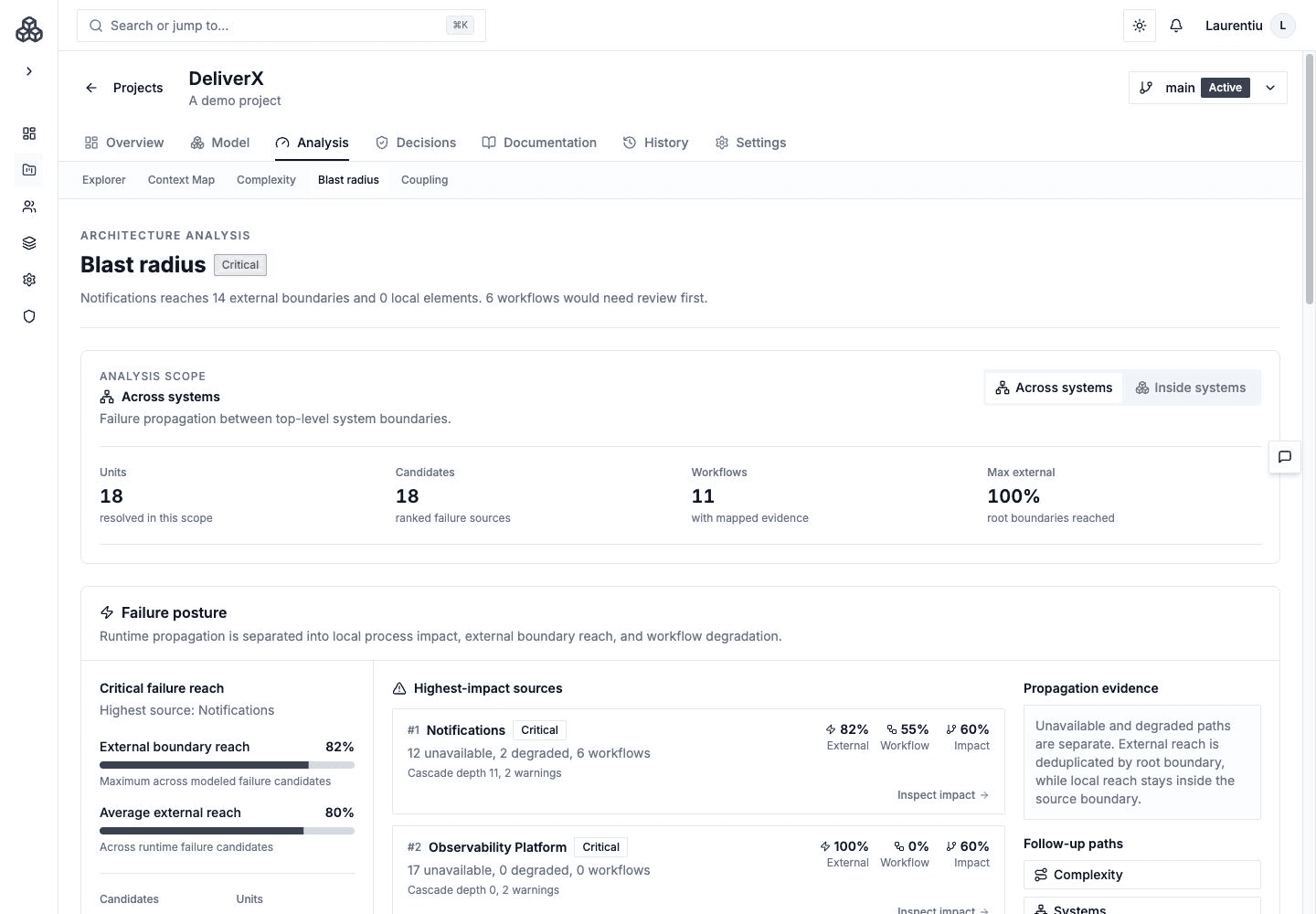
Architecture Lenses
Use context, module, and leaf lenses to examine impact at different hierarchy levels. The context lens emphasizes boundary reach; deeper lenses reveal the specific modules or leaves involved.
Evidence
For each candidate, review:
- Local versus external impact
- Direct and indirect dependency paths
- Maximum cascade depth
- Affected workflows and likely degradation
- Failure posture and impact summary
- Impact diagram and risk matrix position
- Complexity context for the same analysis unit
The result is an architectural estimate based on modeled Relationships and Workflows. It is not a replacement for production telemetry, failure injection, or operational testing.
Investigate A Candidate
Use the candidate explorer to search, filter, and sort the analyzed units. Open a candidate's evidence, then expand an affected workflow to find the First affected mapped step and its downstream path. This connects the dependency to a concrete point in the journey.
Inspect whether the evidence describes an explicit mapped step, a dependency path, or a broader exposure before treating it as a consequence. A Payments dependency in a new-order flow, for example, does not establish that every delivery already underway stops.
Saved Blast Radius results can be reused as Document Artifacts when a review needs to retain the particular investigation.
Review Workflow
- Select the element you plan to change or assess.
- Confirm the lens and failure posture.
- Follow the strongest impact paths.
- Open affected workflows and inspect the impacted steps.
- Identify owners, tests, rollout controls, and reviewers.
- Promote material risk into Decisions or the Handbook.